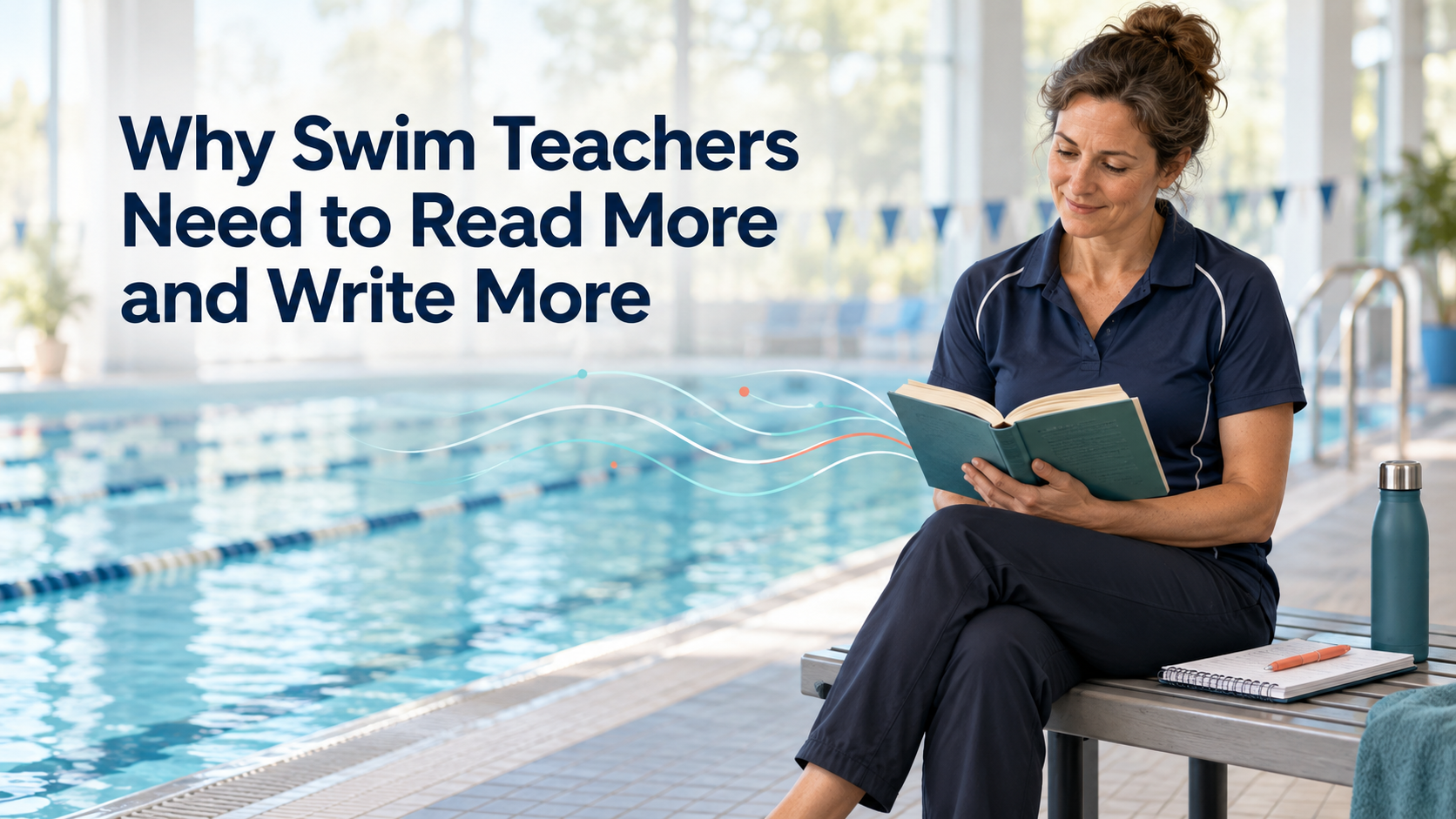
Why Swim Teachers Need to Read More — and Write More
The profession is rich with tacit knowledge that rarely makes it onto the page. Here is why that matters, and what we lose when experienced teachers stop sharing.

There is a particular kind of knowledge that lives in the body of an experienced swim teacher. It is the knowledge of how to read a swimmer's anxiety from the way they hold their shoulders before they enter the water. Of how to adjust a drill mid-session when you can see it is not landing. Of when to push and when to wait.
This knowledge is real. It is hard-won. And almost none of it is written down.
The Problem with Tacit Knowledge
Cognitive scientists call it tacit knowledge — the kind of expertise that is difficult to articulate because it has been so thoroughly internalised. The experienced teacher does not think about these things; they simply know them. And that is precisely the problem.
When knowledge is tacit, it does not transfer easily. It lives in the individual, and when that individual retires or moves on, it goes with them. The profession loses something it cannot easily recover.
This is not unique to swimming. It happens in every skilled profession. But swimming has a particular version of this problem: the pool deck is not a place that encourages reflection. The work is physical, immediate, and relentless. There is always another swimmer who needs attention, another parent waiting for feedback, another session to plan.
Writing requires stopping. And stopping is hard.
What Reading Does for a Teacher
Before we get to writing, a word about reading.
The swim teaching literature is thin. There are textbooks, of course — most of them written for qualification purposes, most of them more concerned with safety procedures than with the art of teaching. There are coaching manuals aimed at competitive swimmers. There are occasional research papers that filter through from sports science.
But there is very little that takes the practice of swim teaching seriously as an intellectual endeavour. Very little that asks: what does it mean to teach someone to move through water? What is the relationship between a teacher's body knowledge and their ability to communicate that knowledge to a learner? How does anxiety affect motor learning, and what can a teacher do about it?
These are not abstract questions. They are the questions that every swim teacher faces every session. And reading — even reading outside the immediate field — helps you think about them more clearly.
I have found more useful ideas about swim teaching in books about music pedagogy, sports psychology, and cognitive science than in most swimming-specific literature. Not because those fields are more rigorous, but because they have had more people writing in them for longer.
The Case for Writing
Writing is not just a way of sharing knowledge. It is a way of creating it.
The act of trying to explain something forces you to understand it more precisely. When you write about why you use a particular drill, you discover what you actually think about it — and sometimes you discover that you do not have a good reason, that you have been doing it out of habit rather than conviction. That is uncomfortable. It is also useful.
Writing also creates a record. Not just for others, but for yourself. The teacher who writes about a session that went wrong — who tries to articulate what happened and why — is doing something that the teacher who simply moves on to the next session is not. They are building a body of knowledge about their own practice.
This is what reflective practice actually means, as opposed to what it is often reduced to in CPD contexts: a tick-box exercise, a form to fill in, a hoop to jump through. Real reflection is effortful and sometimes uncomfortable. Writing is one of the best tools for it.
The Objection
The most common objection I hear when I raise this with other teachers is: I am not a writer.
I understand the feeling. But I think it is based on a misunderstanding of what writing is for in this context. You are not trying to produce literature. You are trying to think clearly and share what you know. Those are skills that can be developed, and they are worth developing.
Start small. Write a paragraph about a session that surprised you. Write a description of a drill you use and why you use it. Write about a learner who challenged your assumptions. You do not need to publish it. You do not need anyone else to read it. The act of writing is the point.
What the Profession Needs
The swim teaching profession needs more people writing about it. Not just researchers and academics — though their contributions matter — but practitioners. People who are in the water every day, who know what it actually feels like to teach a nervous adult to put their face in the water, who have developed their own approaches through years of trial and error.
That knowledge deserves to be on the page. It deserves to be shared, argued with, built upon. It deserves to outlast the individual who holds it.
So: read more. Write more. The profession will be better for it.
Explore Topics
Written by
Michael D. Jones
Swim teacher, educator and writer exploring swimming, learning and teaching beyond the stroke.