The Tablet Is a Tool, Not the Teacher
Technology has become a familiar sight on poolside. Used well, it can make teaching more organised and informed. But there is an important distinction: the tablet is a tool. It is not the teacher.

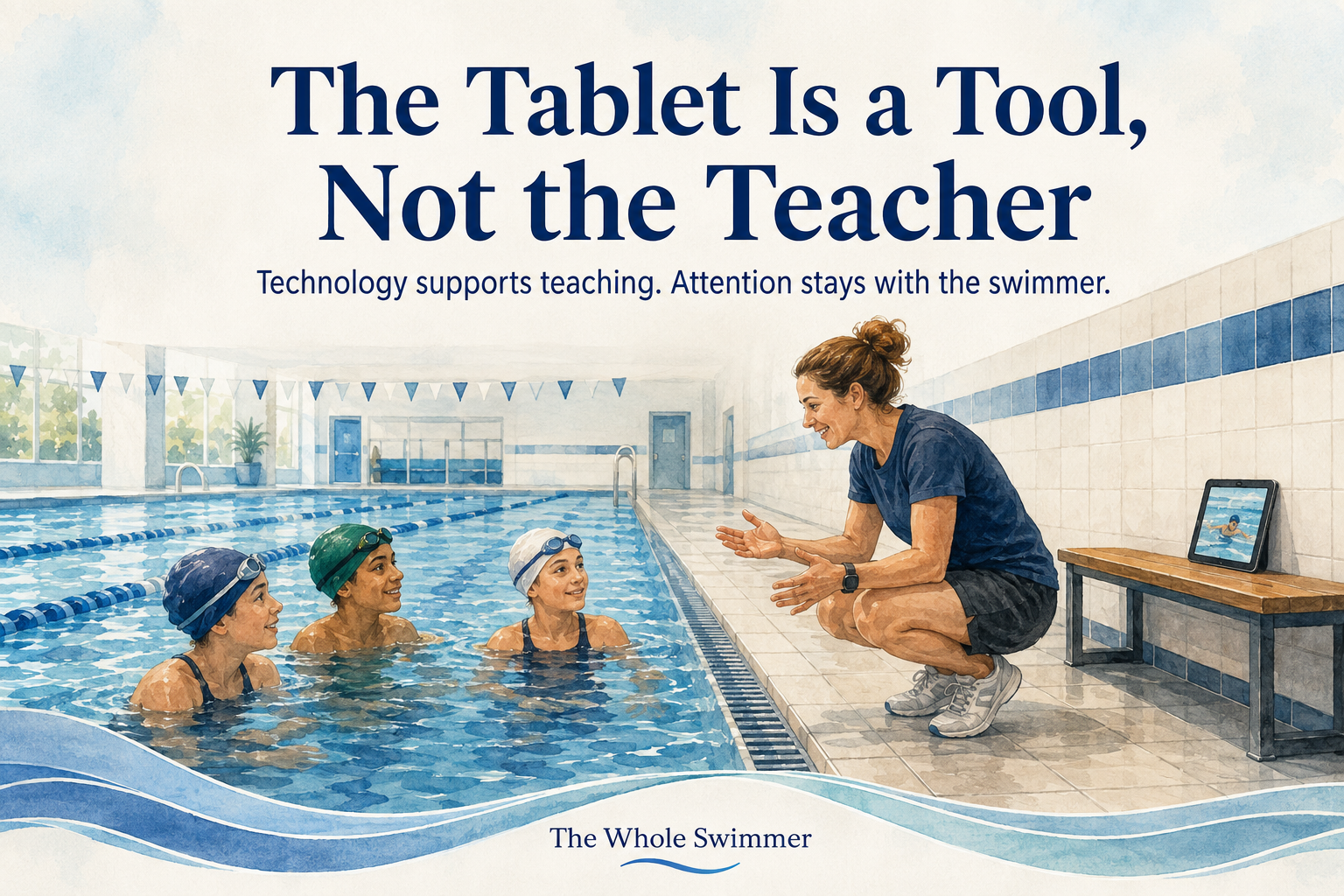
Technology has become a familiar sight on poolside. An iPad or other tablet may hold registers, lesson plans, assessment records, progress notes, videos and details about individual swimmers.
Used well, it can make teaching more organised and informed. But there is an important distinction:
The tablet is a tool. It is not the teacher.
The most important information in a swimming lesson is not always on the screen. It is happening in the water.
It may be the swimmer whose confidence has changed since last week. The child who is becoming tired but has not said anything. The learner who repeatedly looks towards the steps. The swimmer who appears to understand the instruction but begins a completely different movement once they set off.
Those details are noticed through observation, interaction and professional judgement.
When the Screen Takes Our Attention
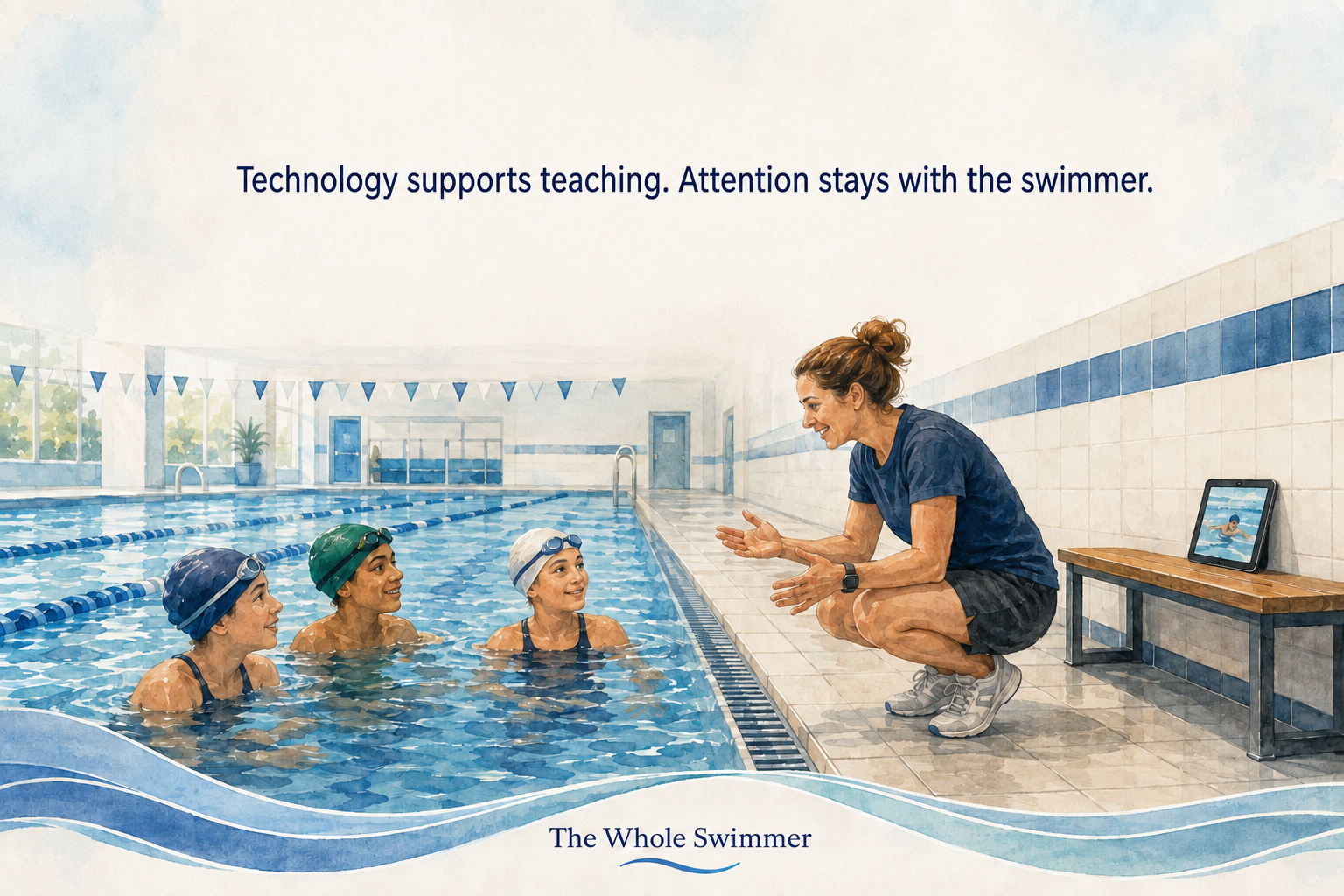
There are legitimate reasons for looking at a tablet during a lesson. A teacher may need to check a swimmer's name, review essential information, record an assessment or remind themselves of the next activity.
The difficulty begins when attention remains with the screen instead of returning to the swimmers.
Looking down can reduce the teacher's awareness of:
- Where each swimmer is
- Who has started or stopped
- Whether an instruction has been understood
- Changes in behaviour or confidence
- Emerging tiredness or distress
- What is happening outside the teacher's immediate line of sight
This becomes especially important when swimmers are moving independently, when a child is likely to move away from the group, or when the teacher is working from within the water. A screen can narrow an already limited field of view.
The question is not simply, "Am I using the tablet?"
It is: "What might I stop seeing while I am using it?"
Recording Progress Is Not the Same as Seeing Progress
Digital assessment systems can encourage teachers to look for whether a swimmer has completed a particular outcome.
Can they travel five metres? Can they float independently? Can they demonstrate the required leg action?
These are useful records, but they do not tell the whole story.
A swimmer may complete the required distance while holding their breath, rushing towards the wall or relying on a movement that causes discomfort. Another may fall slightly short of the prescribed distance but demonstrate greater control, confidence and independence than before.
A tick records an outcome. It does not automatically explain how that outcome was achieved.
The teacher must still observe the quality of the movement, the swimmer's response and what the achievement means for that individual.
Technology Should Support the Teaching Cycle
Much of the value of technology comes before and after the active teaching period.
Before the lesson, a tablet can help the teacher:
- Review the group and individual needs
- Check relevant health, communication or support information
- Prepare suitable activities and adaptations
- Identify swimmers who may need closer observation
During the lesson, where supervision arrangements and the organisation's procedures permit, it might support a specific teaching purpose:
- Confirming essential information
- Showing a carefully selected image or video
- Capturing movement for feedback, where permission and procedures allow
Recording information should not compete with supervising the group. If using the device would interrupt necessary observation, it needs to wait.
After the lesson, technology can support reflection:
- What changed?
- What did the swimmer find difficult?
- Which cue helped?
- What should be tried next time?
- Does another teacher need to know something?
This keeps the device in its proper role: supporting the teacher's thinking rather than directing the lesson.
Video Can Help — but It Still Needs a Teacher
Video can allow a swimmer to see something they cannot easily feel. Slow motion or replay may reveal a head movement, hand entry or timing issue that was difficult to explain verbally.
But showing someone a video is not, by itself, feedback.
The teacher still needs to decide:
- What is important
- Whether the swimmer is ready to see it
- How much information to give
- What language the swimmer will understand
- What they should try next
For some swimmers, video may be helpful. For others, it may create confusion, embarrassment or too much information. Consent, privacy and the organisation's safeguarding procedures must always be considered.
Technology provides the image. The teacher provides the meaning.
The Swimmer Still Needs Human Interaction
A swimmer does not only learn from instructions. They also learn through reassurance, trust, conversation, demonstration and the feeling that someone has noticed them.
An encouraging expression, a well-timed pause or a change in tone cannot be replaced by an assessment screen.
Neither can the small conversations that reveal what is really happening:
"Was that comfortable?"
"Would you like to try it another way?"
"What did you notice?"
"What would help you next?"
These moments allow the teacher to understand the person before making decisions about the swimmer.
Look Up, Look Out and Look Again
The aim is not to remove technology from poolside. Used thoughtfully, it can improve preparation, communication and continuity between lessons.
The aim is to prevent the device from becoming the centre of the lesson.
Before looking at a screen, consider whether the task is necessary at that moment and whether appropriate supervision will be maintained. Afterwards, deliberately reconnect with the whole group — not just the swimmer whose record was open.
Swim schools also have a part to play. Systems and expectations should give teachers a practical opportunity to record information without competing with their attention to swimmers.
Technology can hold information. It can record progress. It can replay movement.
But it cannot replace the teacher's eyes, judgement or relationship with the swimmer.
The tablet may be beside the pool.
The teacher must remain present in the lesson.
Use technology to support what you notice, not to decide what is worth noticing.
Explore Topics
Written by
Michael D. Jones
Swim teacher, educator and writer exploring swimming, learning and teaching beyond the stroke.