Stocking Fillers or Purposeful Practice?
Five minutes left at the end of a swimming lesson. Do we simply fill the time, or can those few minutes become an opportunity for learning, observation, confidence and choice?

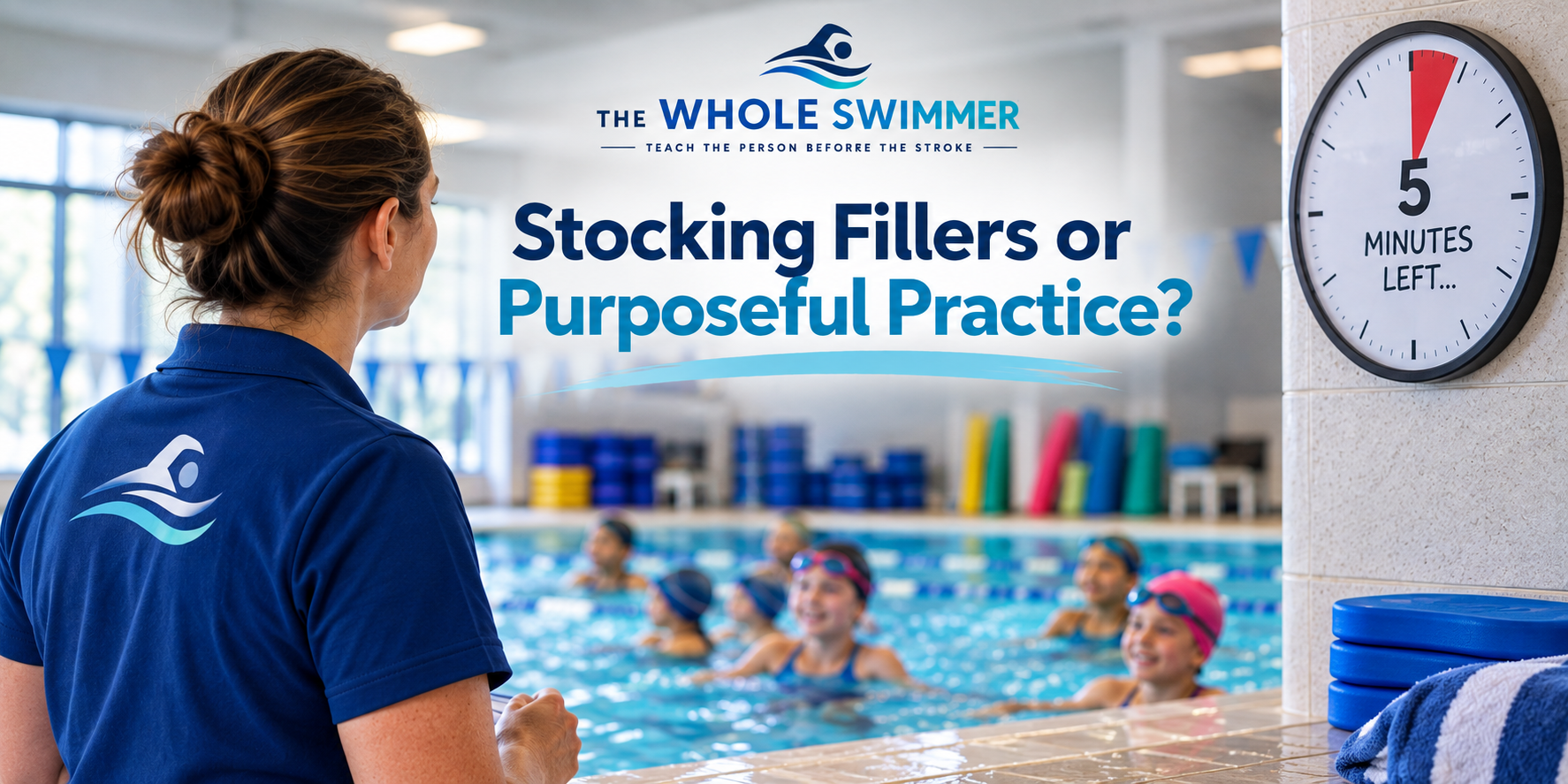
You glance at the clock.
There are five minutes left.
The main part of the lesson is finished. The swimmers have completed what you planned, there probably isn't enough time to introduce something completely new, and the next class will soon be arriving.
So what happens?
"Right — who wants a game?"
There is nothing wrong with that.
Fun belongs in swimming lessons. Games can develop skills, confidence, cooperation and enjoyment. Sometimes finishing with a favourite game is exactly the right thing to do.
The problem isn't the game.
The question is why we chose it.
Did we choose it because of what we have seen in the swimmers during the lesson?
Or did we choose it simply because there were five minutes left and we needed something to fill them?
That is the difference between a stocking filler and purposeful practice.
The Same Activity — A Different Purpose
Imagine finishing a lesson with a simple sinker game.
Scatter several sinkers in an appropriate depth and ask the swimmers to retrieve them.
As a stocking filler, the thinking might be:
We've got five minutes left. They enjoy collecting sinkers.
There is nothing necessarily wrong with that. The swimmers may have fun and finish the lesson happy.
But now imagine choosing exactly the same game after noticing that one swimmer remains reluctant to submerge their face.
The activity changes very little.
The teacher's thinking changes considerably.
Rather than repeatedly instructing the swimmer to put their face underwater, the teacher might position objects at different depths and allow the swimmer to decide which ones to retrieve.
Now the activity offers opportunities for choice, gradual exploration, confidence and independence.
Another swimmer might be encouraged to streamline towards an object. Another could explore controlling their body position while reaching towards the pool floor.
The game has not suddenly become a drill.
The swimmers do not need to know every reason behind the teacher's choice.
They can still simply be collecting sinkers.
Purpose sits behind the activity, not necessarily inside the instructions.
Are They Really Spare Minutes?
Five minutes does not sound like much.
In a 30-minute lesson, however, five minutes represents one-sixth of the available lesson time. Across several lessons, those little pieces of time begin to add up.
That does not mean every second needs to be tightly controlled or that every activity needs a measurable technical outcome.
Quite the opposite.
Swimmers need opportunities to explore, play, talk, experiment, make choices and simply enjoy being in the water.
Sometimes the purposeful decision is for the teacher to stop teaching for a moment and start watching.
Give the swimmers a challenge.
Give them some equipment.
Give them a choice.
Perhaps ask:
"Can you create something?"
Then observe what happens.
Who experiments? Who follows someone else? Who takes the lead? Who hangs back? Who tries something they would not attempt when directly instructed? Who finds another way?
Those final minutes may reveal something about the swimmer that another organised length never would.
Purposeful Does Not Mean Serious
Purposeful practice can still involve laughter.
It can involve floats, sinkers, races, challenges and games. It can even involve allowing swimmers to decide what happens next.
To them, they may simply be playing.
The teacher, however, might be observing balance, confidence, breathing, decision-making or interaction with others.
Those final few minutes could reinforce something explored earlier in the lesson, revisit a previous skill, develop confidence, encourage independence or simply allow a swimmer to finish experiencing success.
The activity has not stopped being fun because the teacher has given it a purpose.
Play and Learning Are Not Opposites
Using a game does not mean that learning has stopped.
Games-led approaches already have an established place within learn-to-swim teaching. Swim England's Learn to Swim Framework, for example, deliberately incorporates fun and games while developing fundamental aquatic skills.
The important question is therefore not:
"Are they playing or are they learning?"
It is:
"What opportunities for learning does this play create?"
A swimmer collecting sinkers might also be exploring submersion, buoyancy, orientation and confidence.
A relay could involve coordination, decision-making or cooperation.
A swimmer-created challenge might allow the teacher to see how learners apply skills when the solution has not been prescribed for them.
The activity can be enjoyable and purposeful.
One does not cancel out the other.
Ask a Different Question
Instead of asking:
"What can I do for the last five minutes?"
try asking:
"What could these five minutes give this swimmer?"
That small change shifts the emphasis from filling time to creating opportunity.
Perhaps a swimmer has spent most of the lesson reluctant to put their face in the water. The final minutes could provide an enjoyable activity where getting the face wet happens naturally rather than through another formal instruction.
Perhaps the group has been working on front crawl breathing. Instead of another length, they could be given a short challenge that allows them to experiment with rhythm.
Or perhaps the lesson has required a great deal of concentration and instruction. The purposeful choice might actually be to hand some control back:
"You have four minutes. Can you invent a game using these three pieces of equipment?"
Same pool.
Same few minutes.
Very different purpose.
A Purposeful Five-Minute Toolkit
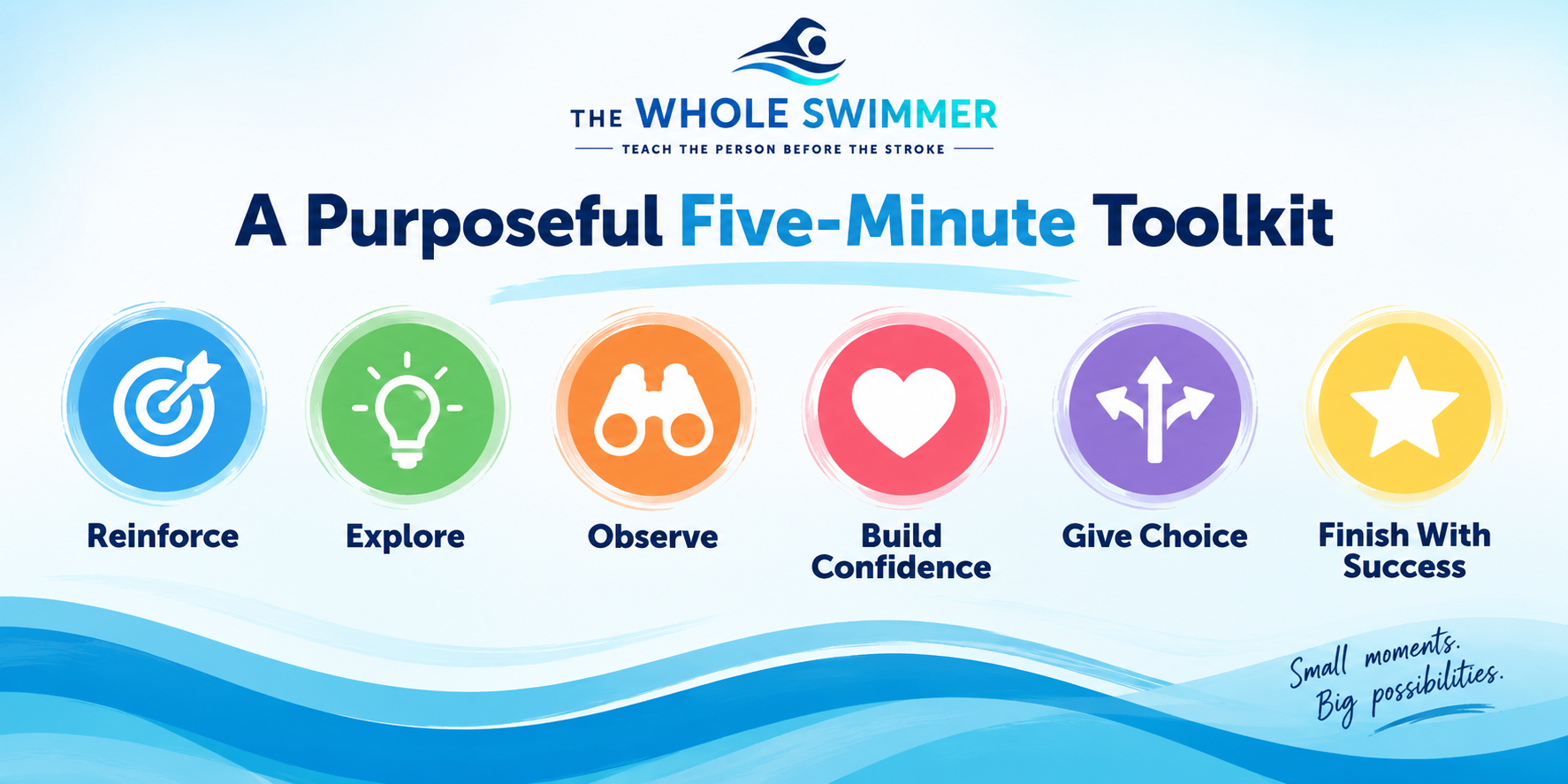
You do not necessarily need a collection of special five-minute activities.
You need a collection of purposes.
Reinforce — Return to something already explored, perhaps changing the challenge, equipment, distance or environment. Ask: What is worth experiencing once more?
Explore — Give the swimmer a problem without immediately providing the solution. Ask: What could they discover for themselves?
Observe — Give the swimmers an activity, challenge or choice — and watch. Ask: What could I learn if I stopped instructing?
Build Confidence — Sometimes the final few minutes are an opportunity to return to something familiar and successful. Ask: What could help this swimmer leave feeling more capable than when they arrived?
Give Choice — Let the swimmer make a decision: equipment, activity, distance, challenge or skill. Ask: Where could I hand some control back to the swimmer?
Finish With Success — A lesson does not always need to finish at the point of greatest difficulty. Sometimes the purposeful decision is to finish with something enjoyable, familiar or achievable. Ask: What would be a good final experience for this swimmer today?
The activity itself may be very simple.
A float. A sinker. A width of the pool. A challenge. A choice. A familiar game.
The purpose comes from the teacher's decision about why this activity, for these swimmers, at this moment.
The Last Five Minutes May Start the Next Lesson
Those final minutes do not have to sit outside the teaching process. They can become part of the Whole Swimmer Teaching Cycle:
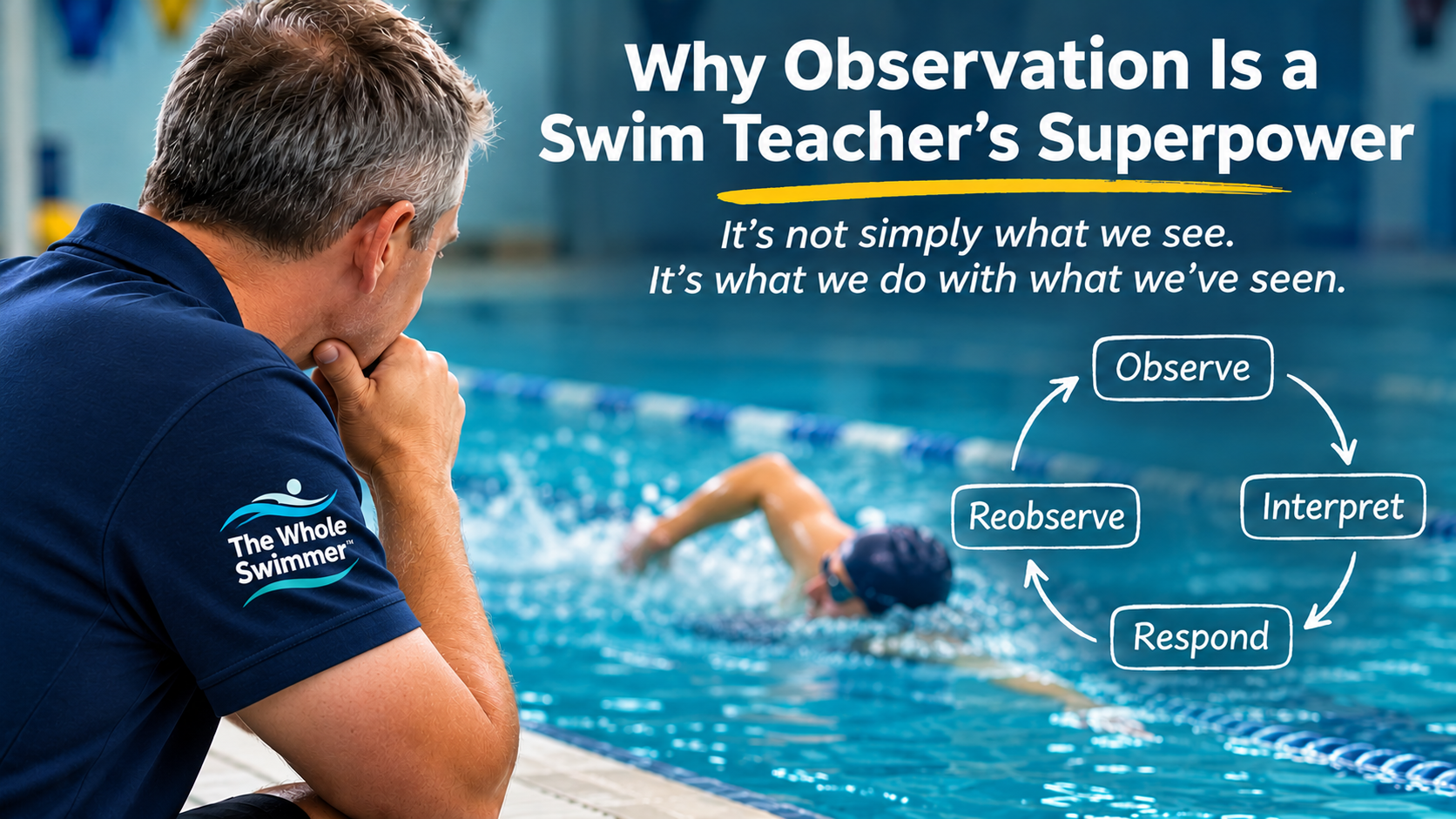
Observe → Adapt → Practise → Reflect
A teacher might give swimmers a familiar game and notice that one avoids submerging, another experiments naturally with a different body position, while another becomes much more confident when allowed to choose what to do.
Those observations matter.
They might lead to an adaptation there and then.
They might suggest something to practise differently.
Or they might simply become a thought to carry away from the pool:
"I want to explore that with them next time."
In that sense, the end of one lesson can become the beginning of the next.
Not Every Minute Needs Another Length
Purposeful practice should not become an excuse for squeezing more repetition into the lesson. "Five minutes left" does not automatically mean: "Let's see how many more lengths we can fit in."
Sometimes the swimmer has already done enough physical practice.
The better opportunity may be confidence.
Curiosity.
Choice.
Play.
Conversation.
Or simply leaving the water thinking:
"I did that."
That feeling may be more valuable than another technically imperfect 25 metres.
Poolside Pause
The next time you find yourself looking at the clock with five minutes remaining, resist automatically reaching for the usual stocking filler. Look at the swimmers in front of you and ask:
What have they done today?
What do they need now?
What could I learn by watching them?
What could these five minutes give them?
The answer might still be a game.
But now you know why you are playing it.
There are no spare minutes in a swimming lesson — only minutes we haven't given a purpose yet.
"Next time you have five minutes left, try choosing the purpose before choosing the activity."
Explore Topics
Written by
Michael D. Jones
Swim teacher, educator and writer exploring swimming, learning and teaching beyond the stroke.