Observation Is a Swim Teacher's Superpower
Before we can teach effectively, we need to see clearly. This post explores why observation is the most underrated skill in swim teaching — and how to sharpen it.

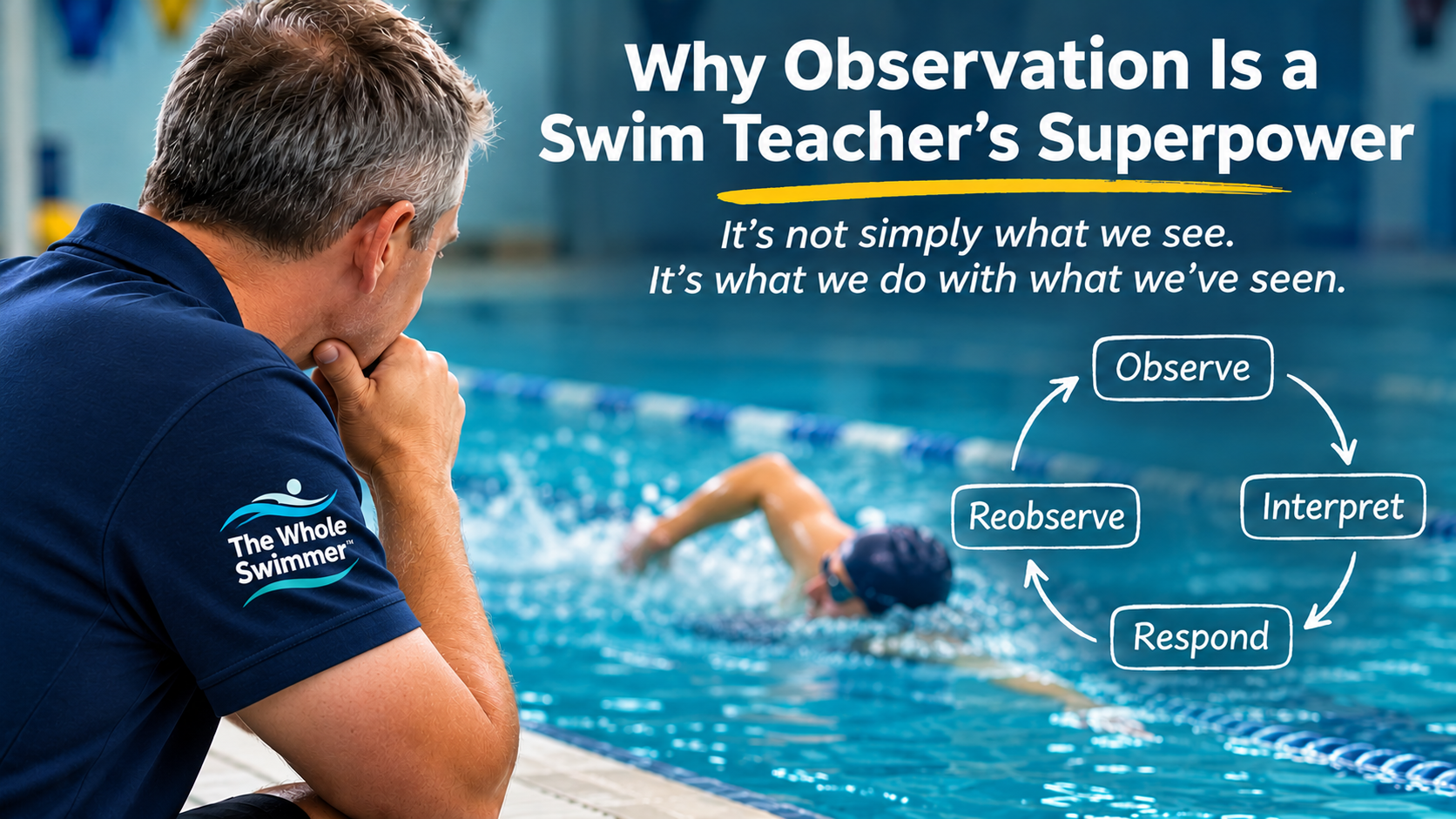
It's not simply what we see. It's what we do with what we've seen.
A swimmer pushes away from the wall and begins swimming towards the other end of the pool.
We watch, offer a correction and prepare the next activity.
But what did we actually see?
Did we notice their body position changing halfway through? The moment their breathing became hurried? Perhaps a slight hesitation before attempting something unfamiliar?
Or were we mainly looking for the technical points we'd been taught to assess?
As swim teachers, we spend considerable time learning how swimming strokes should be performed. We study body position, leg action, arm action, breathing and timing. We learn progressions, identify common faults and explore ways to correct them.
All of this knowledge matters.
But knowing what a swimming stroke should look like isn't necessarily the same as understanding what is happening while someone is learning it.
And recognising a difficulty doesn't automatically tell us what to do next.
The superpower isn't simply seeing what happens. It's understanding what we've seen, deciding what to do with it and being willing to question whether our decision helped.
Are We Really Watching?
Think about everything happening during a typical swimming lesson.
We're maintaining safety, managing the group, giving instructions, organising activities, assessing progress and responding to individual needs.
Somewhere amongst all that, we're also expected to observe.
But how much time do we actually spend watching a swimmer with a particular purpose in mind?
Not simply ensuring they reach the other end safely, but looking at how they move, how they respond and what changes during an activity.
There's a difference between supervising a swimmer and making a focused teaching observation.
Both are important, and one should never compromise the other.
Imagine watching a swimmer complete 25 metres of front crawl.
Their legs are sinking.
We've identified something that might need attention.
But when did their legs begin to sink?
Were they maintaining a reasonable body position during the first few metres? Did something change when they turned to breathe? Did their movements become increasingly tense?
Sometimes what happens before a difficulty tells us more than the difficulty itself.
Purposeful observation isn't simply about watching more carefully. It's about knowing what we're looking for and why it matters.
Looking Beyond the Technical Model
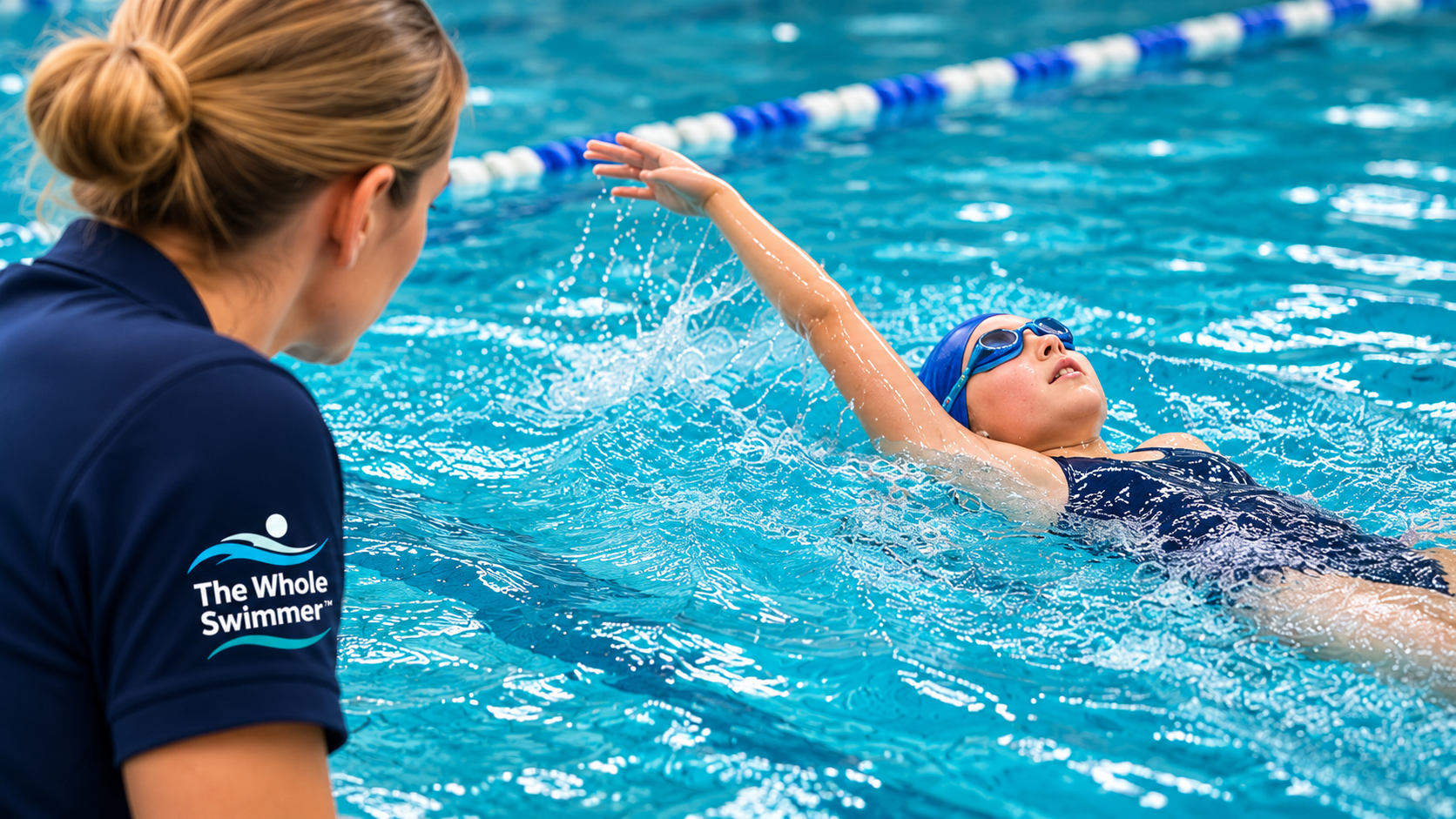
When learning stroke analysis, we're taught to recognise the characteristics of effective swimming.
We compare what we see with the technical model and identify areas that need improvement.
But are we sometimes so focused on what isn't working that we overlook what is?
Consider a young swimmer learning backstroke.
Their hips drop, their knees rise and their kick becomes increasingly ineffective.
We recognise the difficulty and offer familiar corrections.
"Keep your hips up."
"Keep your head still."
"Kick from your hips."
But nothing much changes.
What next?
Perhaps the swimmer hasn't understood the instruction.
But could something else be happening?
Perhaps they're still developing the coordination needed to maintain balance while moving their legs.
Perhaps they're uncomfortable lying on their back.
Perhaps their head position or unnecessary muscular tension is affecting their balance.
Or perhaps they can maintain an effective position while floating but lose it as soon as they begin kicking.
The same visible difficulty can have several possible explanations.
And that's why simply recognising the technical fault isn't always enough.
What happens if we ask the swimmer to float without kicking?
What changes when we introduce gentle kicking?
Can they maintain their position with some support?
Does the difficulty appear immediately or develop over distance?
Each observation may help us understand a little more.
And while we're looking at what's difficult, what about what's working?
Perhaps the swimmer is becoming more comfortable on their back. Perhaps their head position has improved. Perhaps they can maintain their balance for longer than before.
These are developments worth recognising, even if the complete stroke isn't yet effective.
Seeing the difficulty is not the same as understanding it. And recognising what's working can be just as valuable as identifying what needs improvement.
The Adult Learner: What Did That Feel Like?
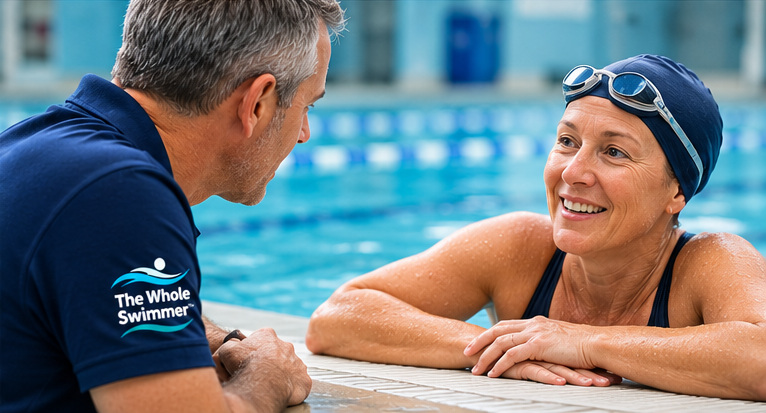
The same principles apply when teaching adults, although the experiences they bring into the pool can be very different.
Consider an adult who regularly cycles, runs or participates in other endurance activities.
They're physically active and reasonably fit, yet struggle to swim 25 metres of front crawl without stopping.
From the poolside, we might notice hurried breathing, a raised head and increasing tension.
The obvious response might be to correct their breathing technique.
But what if we asked a question first?
"How did that feel?"
It's a question I often use when teaching adults, sometimes before offering any feedback of my own.
The response can be revealing.
Perhaps the swimmer felt comfortable until they turned to breathe.
Perhaps they thought they were exhaling continuously.
Perhaps they noticed their legs becoming tired, even though we'd been concentrating on their breathing.
What we observe from the poolside and what the swimmer experiences aren't necessarily the same.
The swimmer receives information through their own senses. They feel their balance changing, experience the effort involved and may recognise when a movement becomes uncomfortable.
We observe from a different perspective.
Neither perspective automatically provides the complete explanation.
But bringing them together can help us make better decisions.
Asking a swimmer to reflect on an attempt also gives them an opportunity to develop awareness of their own movement.
Rather than immediately being told what was wrong, they're encouraged to consider what happened.
And that matters whether we're teaching an adult or a child, although the questions and language we use may differ.
Adult learners also bring previous experiences, expectations and motivations into the pool.
Some want detailed explanations. Others prefer to learn through movement and experimentation.
Some may have considerable confidence in other activities but feel uncertain in the water.
We shouldn't assume that every adult learns in the same way, any more than we should assume that every child does.
And we should recognise that not every difficulty can be explained through technique or teaching. Sometimes there may be factors beyond what we can determine from the poolside.
Sometimes the most useful feedback begins with a question rather than an answer.
When We Don't Know What to Do Next
We've probably all experienced it.
We've demonstrated a movement, explained what we're looking for and introduced an activity that we believe will help.
But the swimmer continues to struggle.
What next?
For a newly qualified teacher, this can be particularly uncomfortable.
There may be a feeling that, having completed the qualification, we should know the answer.
And admitting that we don't know might feel like admitting we're not competent.
But there's a difference between not knowing how to teach and not yet understanding why a particular swimmer is finding something difficult.
Even experienced teachers encounter situations they haven't seen before.
No qualification, course or collection of teaching activities can prepare us for every swimmer.
Perhaps we need to become more comfortable saying:
"I haven't worked out why that's happening yet."
And perhaps we need to create teaching environments where asking another teacher for their thoughts is encouraged rather than seen as a weakness.
After all, if we're encouraging swimmers to experiment, make mistakes and learn, shouldn't we be prepared to do the same?
Not knowing isn't necessarily a weakness. Pretending to know can prevent us from learning.
The Search for the Next Activity
When something isn't working, it's tempting to look for another activity.
Another drill. Another demonstration. Another way of explaining the movement.
And today, we don't have to look very far.
Social media offers an almost endless collection of swimming activities and teaching ideas.
A short video demonstrates a particular drill. The presenter confidently explains that it's the solution to a common problem.
It has thousands of views, likes and enthusiastic comments.
It must be worth trying, surely?
Perhaps it is.
Sharing ideas is valuable, and we can learn a great deal from other teachers and coaches.
But popularity doesn't necessarily make an activity appropriate for every swimmer.
Nor does a confident explanation mean we've been given the complete answer.
An activity that works particularly well for one swimmer may achieve very little with another.
Before introducing something we've seen online, perhaps we should ask ourselves a few questions.
What is the activity intended to achieve?
Why might it help this particular swimmer?
What does the swimmer need to be able to do before attempting it?
And how will we know whether it has made a difference?
The issue isn't where the activity came from.
It's whether we've considered its purpose.
Knowing an activity is useful. Understanding when, why and for whom to use it is professional judgement.
Observation Is a Teaching Skill Too
We teach new swimming teachers about strokes, progressions, activities and common faults.
But do we spend enough time helping them understand what to do with their observations?
Knowing the five teaching points of a stroke doesn't automatically mean knowing why a swimmer is struggling.
And recognising a technical difficulty doesn't necessarily tell us which activity to introduce next.
This is where mentoring can make a difference.
When observing another teacher, it's easy to concentrate on what they did or didn't do.
But perhaps we should spend more time exploring why they made particular decisions.
What did they notice?
What did they think was happening?
Why did they choose that activity?
What changed when the swimmer attempted it?
What might they try next?
These conversations can help teachers develop their own judgement rather than simply add more activities to their collection.
They also encourage us to recognise that teaching expertise develops through experience, reflection and a willingness to question our assumptions.
We shouldn't simply teach teachers what to look for. We should help them understand what to do with what they see.
From Observation to Action — and Back Again
So what do we actually do with our observations?
We notice something about a swimmer's movement.
We consider what might be happening.
Perhaps we ask the swimmer how the movement felt.
Then we decide whether to offer feedback, adapt the activity, change the environment or allow another attempt.
And importantly, we look again.
Did our response help?
Did the swimmer become more confident?
Did the movement become more effective?
Or did something unexpected happen?
We might describe this as a continuing cycle:
Observe → Interpret → Respond → Reobserve
But it isn't intended to be another rigid teaching formula.
Sometimes we need more information before deciding what to do.
Sometimes a simple question provides that information.
And sometimes the most appropriate response is to allow the swimmer another opportunity without immediately intervening.
A swimmer experimenting with a new movement may discover something independently.
Of course, there are occasions when immediate intervention is necessary, particularly where safety is concerned.
But effective teaching doesn't always require another instruction.
Choosing not to intervene can be just as deliberate a teaching decision as choosing to correct something.
The Value of Standing Still
Swimming lessons can be busy places.
There are activities to deliver, skills to develop, outcomes to assess and swimmers waiting for their turn.
And sometimes we may feel that every moment needs to be filled with another activity, another instruction or another correction.
But does being busy necessarily mean that learning is taking place?
A lesson can appear busy without us fully understanding what swimmers are experiencing.
Equally, taking a few moments to observe carefully may be one of the most valuable things we do during a lesson.
That doesn't mean standing still automatically makes us effective teachers.
We still need to maintain supervision, keep swimmers appropriately engaged and organise activities with purpose.
But perhaps we should recognise that observation is itself an active part of teaching.
It requires attention, knowledge, curiosity and judgement.
And sometimes it requires the confidence to resist offering an immediate answer.
Poolside Pause
During your next lesson, take a moment to observe before offering another correction.
Ask yourself:
What is this swimmer already doing successfully?
What am I assuming rather than actually observing?
Is my next activity based on what the swimmer needs or simply what I planned?
There may not be an immediate answer.
And that's perfectly reasonable.
Explore Topics
Written by
Michael D. Jones
Swim teacher, educator and writer exploring swimming, learning and teaching beyond the stroke.