Who Looks After the Swim Teacher?
A swim teacher may spend hours surrounded by people, yet have surprisingly little meaningful contact with another adult. The overlooked wellbeing of the person standing poolside.

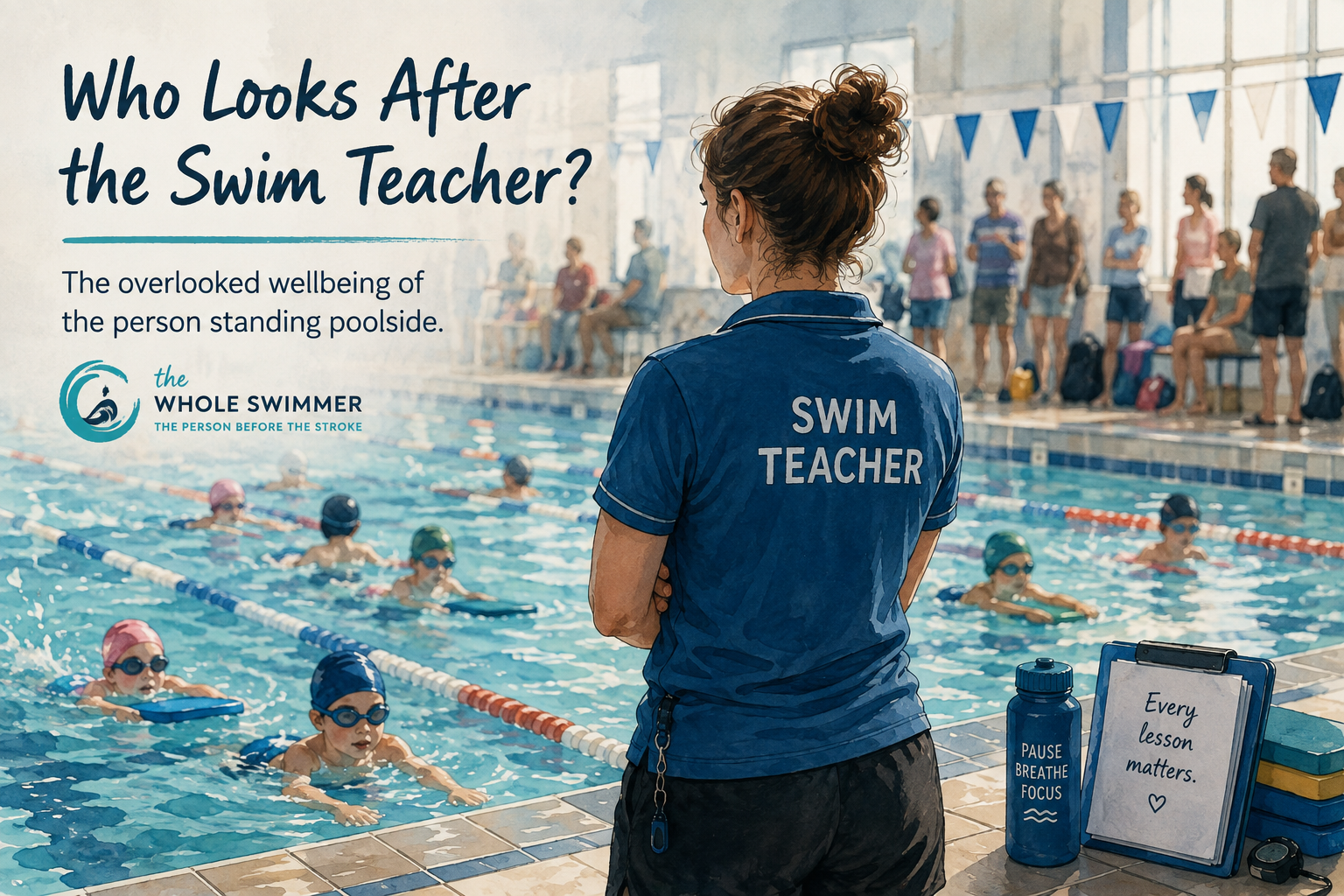
The Overlooked Wellbeing of the Person Standing Poolside
A swim teacher may spend hours surrounded by people, yet have surprisingly little meaningful contact with another adult. Lesson follows lesson. Swimmers, parents and colleagues all arrive with their own needs, questions and expectations. The teacher remains attentive, encouraging and responsible — but who notices how the teacher is doing?
A swimming pool is rarely a quiet place. There are voices, whistles, splashing water and the constant movement of people around us. From the outside, swim teaching may appear to be an extremely social job.
Surrounded by People, Yet Sometimes Alone
Yet being surrounded by people is not the same as feeling connected to them.
A teacher may spend several hours speaking almost continuously without having a meaningful conversation with another adult. Most communication is purposeful: giving instructions, offering encouragement, answering a parent's question or passing information to the next teacher. There may be little opportunity to pause, talk or simply ask one another, "How are you doing?"
During those hours, the teacher must remain present for every swimmer. They notice the nervous child hovering beside the steps, the adult trying to hide their fear and the swimmer whose confidence has suddenly disappeared. They adjust activities, manage behaviour, monitor safety and try to ensure that everybody leaves feeling they have achieved something.
But while the teacher is noticing everybody else, it is surprisingly easy for nobody to notice the teacher.
This does not necessarily mean that the teacher is unhappy or unsupported. Many teachers love being on poolside and gain enormous satisfaction from helping others. However, even enjoyable work can be tiring, and responsibility can feel heavy when it is carried quietly from one lesson to the next.
Swim teaching is not only about helping someone develop a stroke or complete a distance. Teachers also hold fear, frustration, disappointment and expectation — sometimes all within the same lesson.
The Emotional Weight of Teaching
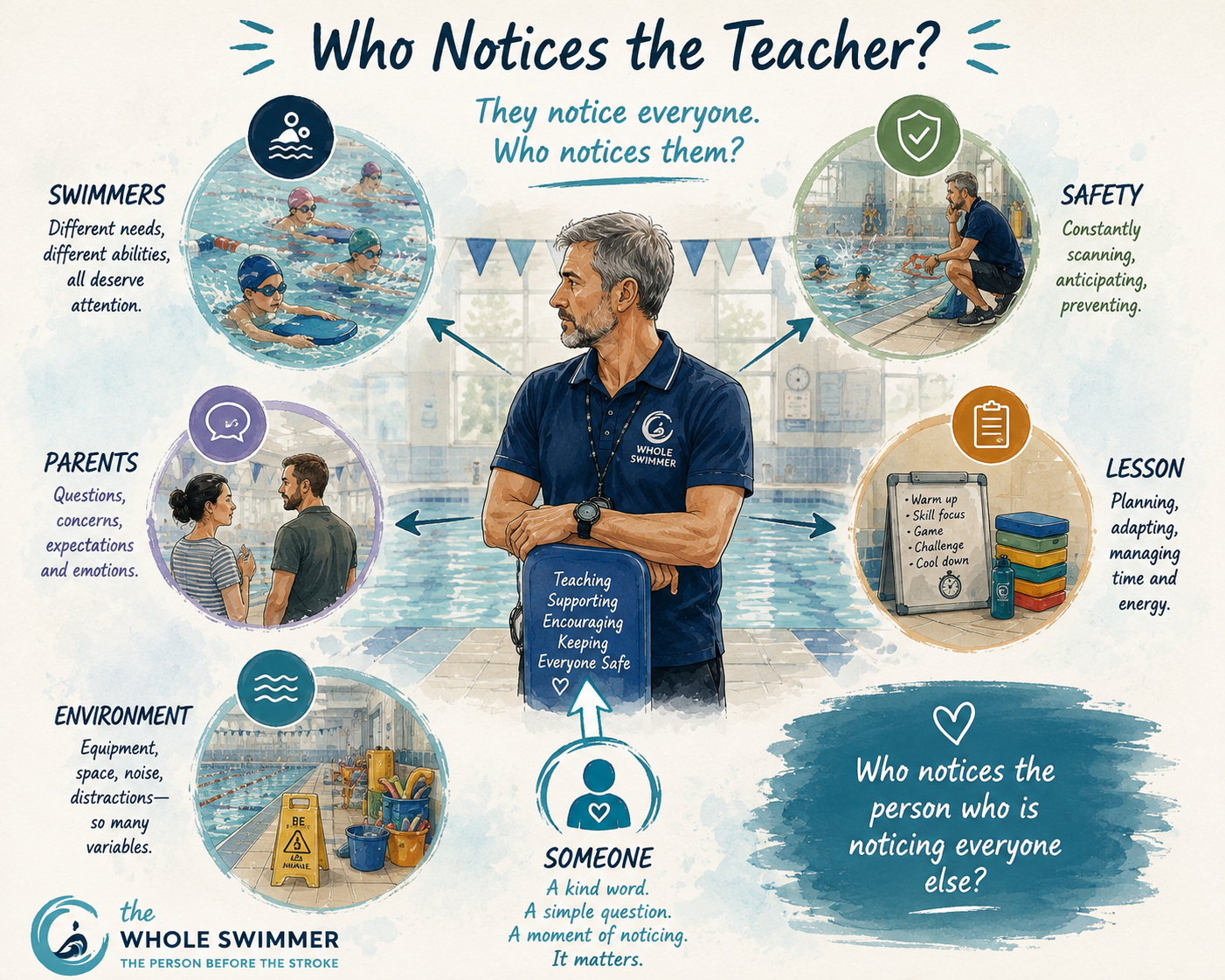
A swimmer may arrive upset after a difficult day. A child may refuse to enter the water. An anxious parent may question every decision, while another swimmer needs constant encouragement simply to keep trying. The teacher absorbs these emotions while remaining calm, positive and attentive.
They may also carry their own concerns: something happening at home, worries about their health, tiredness after a long day or the feeling that a lesson did not go as well as they had hoped. These do not disappear when the teaching session begins. They are often placed quietly to one side because the swimmers still need their teacher.
The moments of success can be wonderful. A first unaided float, a frightened adult putting their face in the water or a child reaching the side independently can make the whole session worthwhile. But the difficult moments can follow a teacher home too.
A comment from a parent, a swimmer who became upset or a decision made in a split second may be replayed long after the pool has fallen quiet. Teachers often ask themselves whether they could have explained something differently, noticed something sooner or done more.
Reflection is an important part of good teaching. But without support, healthy reflection can gradually become self-doubt.
The Moments Between Lessons
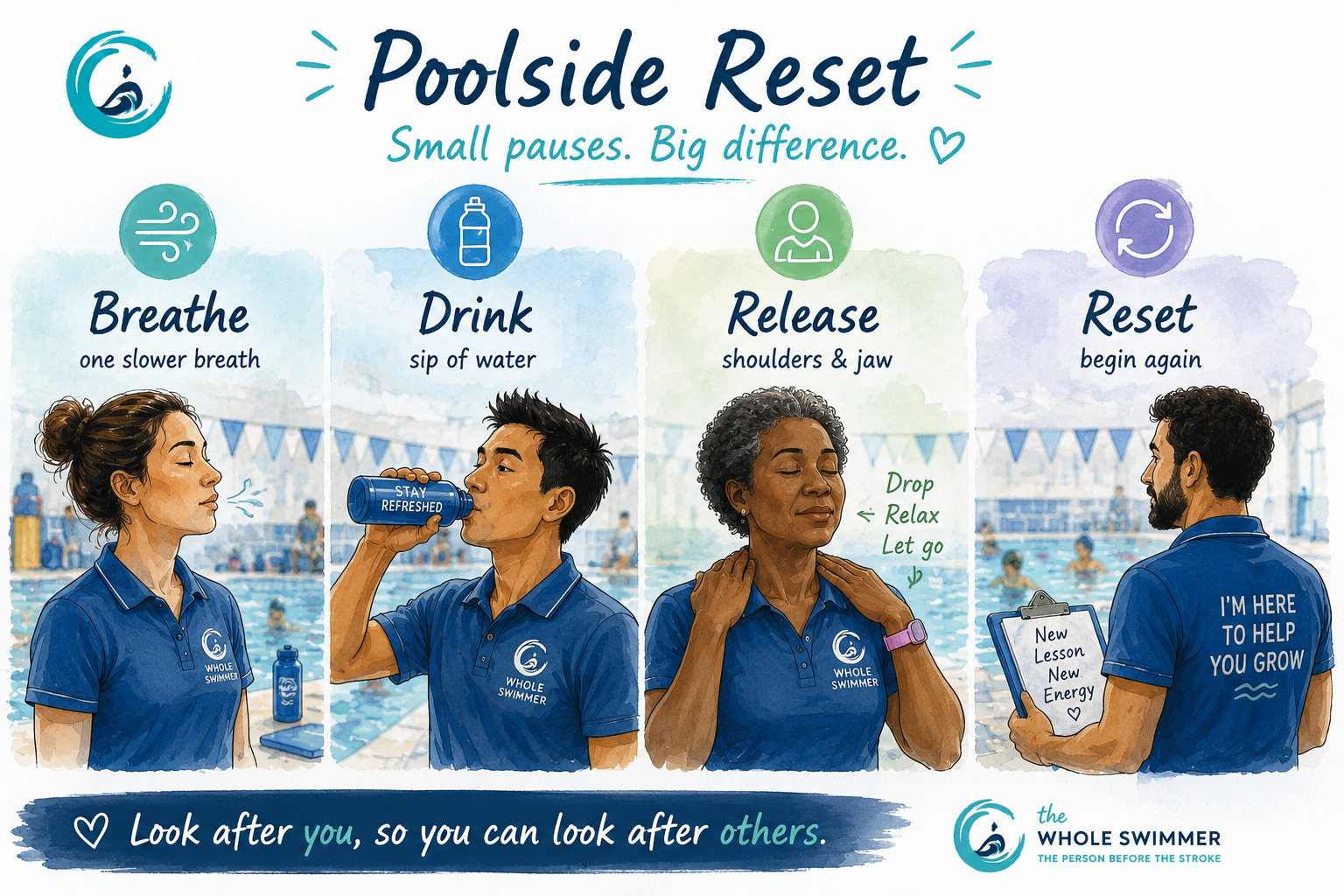
There is rarely a clear ending to one lesson before the next begins. One group climbs out as another gathers at the poolside. A parent has a question, equipment needs to be moved, registers must be completed and the next set of swimmers is already waiting.
The teacher may carry the previous lesson straight into the next one. A difficult interaction, a safety concern or the feeling that a swimmer has struggled does not automatically disappear when the lesson ends. Without even a short pause, these thoughts can remain in the background while the teacher tries to begin again with fresh energy.
A meaningful pause does not have to be long. Sometimes there is only enough time to take one slower breath, drink some water, relax the shoulders or briefly notice how the body feels. These small moments will not remove the demands of the session, but they can prevent several lessons from becoming one long, uninterrupted period of tension.
This is where mindfulness can become practical rather than another task to complete. It does not require silence, closed eyes or a perfect place to sit. Poolside mindfulness might simply mean feeling both feet on the floor, noticing the breath without trying to change it or deliberately releasing the grip of the hands and jaw.
The pause may also be shared. A brief word from a colleague — "Are you all right?" or "Do you need a minute?" — can interrupt the feeling that everything must be managed alone. The question only helps, however, when there is enough time and trust for the teacher to answer honestly.
Even when the timetable cannot provide a proper break between every lesson, the working culture can still recognise the value of these small resets. Beginning the next lesson feeling present is better for the teacher, the swimmers and the quality of the teaching.
There is another transition that can be easily overlooked: the end of the teaching session itself. After several hours of noise, concentration and responsibility, the final swimmer leaves, the equipment is put away and suddenly the poolside becomes quieter. The teacher may walk to the car or travel home with, for the first time that evening, space to think about what has happened.
Sometimes that is when a difficult moment returns. A conversation with a parent, concern about a swimmer or uncertainty about a decision may have been pushed aside while the next lessons demanded attention. Once the teaching stops, those thoughts can become much louder.
Perhaps finishing a session deserves its own small pause too. Not necessarily to analyse every lesson, but simply to recognise what we are carrying before we take it home with us. Some things can be reflected upon later, some may need to be shared with a colleague or team leader, and some may simply need to be acknowledged before we move on with the rest of our day.
So, Who Looks After the Swim Teacher?
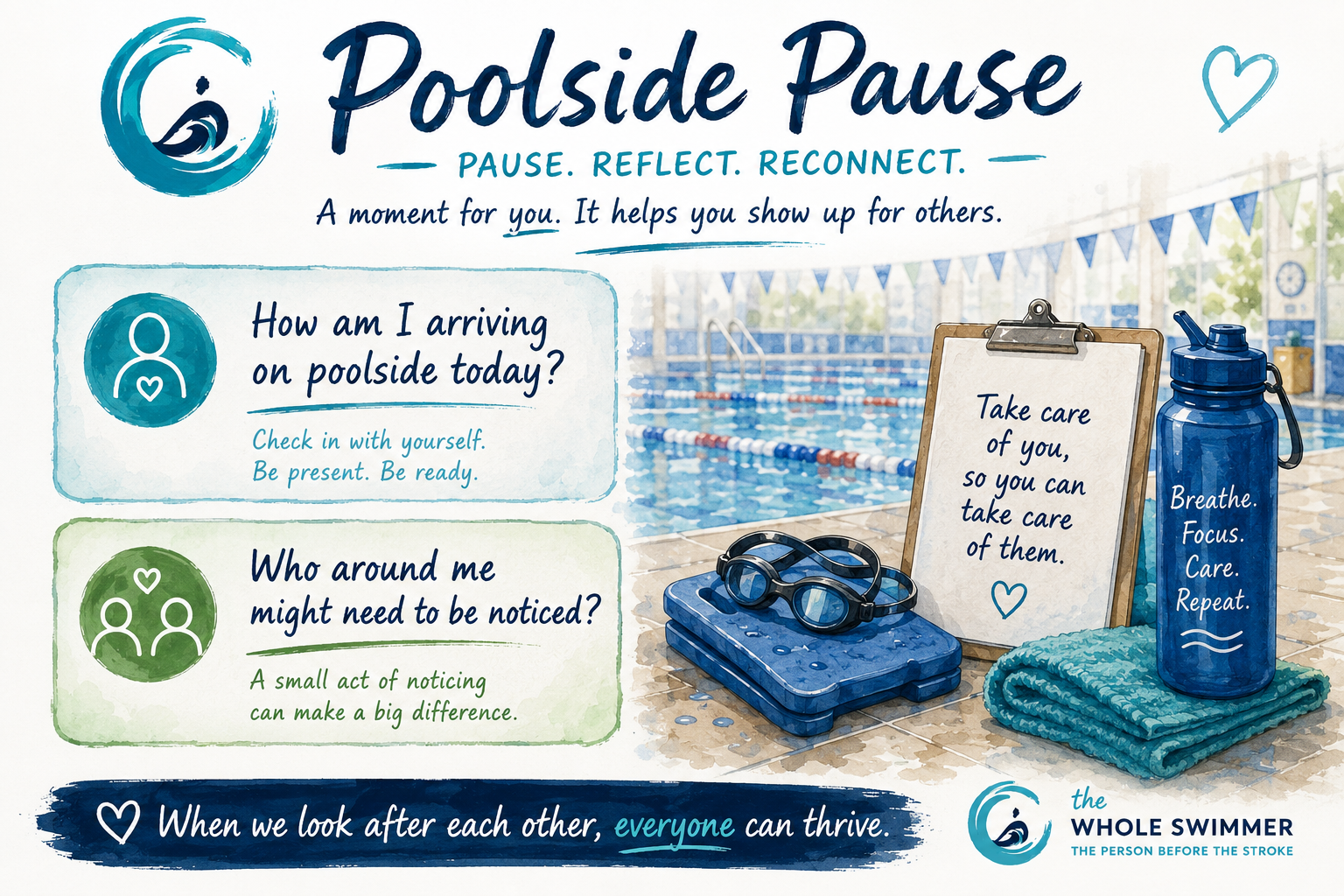
Perhaps the answer is not one person.
Looking after the swim teacher may simply begin with recognising that this side of teaching exists. Teachers, colleagues, team leaders and those who organise swimming programmes can all contribute in different ways. Sometimes the smallest things matter most — a conversation between lessons, a shared laugh, a chance to pause or simply somebody noticing that it has been a long session.
There may be no perfect structure for achieving this. Pools, programmes and teaching environments differ enormously, and what works in one setting may not be possible or necessary in another. What we can share, wherever we teach, is an awareness of one another as people as well as professionals.
None of this needs to make swim teaching feel like a problem that must be solved. It is a rewarding role filled with laughter, achievement and moments that stay with both teacher and swimmer for years. Looking after teachers helps protect everything that makes the role special.
A supported teacher is more able to be patient with the hesitant swimmer, creative when an activity is not working and fully present when somebody achieves something for the first time. Teacher wellbeing and swimmer wellbeing are not competing priorities. They are closely connected.
Perhaps looking after the swim teacher begins with something simple: noticing.
Noticing the colleague who has not stopped for a drink. The teacher who has become quieter than usual. The person rubbing a painful knee between lessons or taking a moment alone after a difficult conversation. It also means noticing ourselves — our breathing, our tiredness, our changing mood and when we are beginning to carry too much.
We will not always know what another person needs, and we do not need to diagnose or solve every difficulty. Sometimes it is enough to ask, listen and make it clear that they do not have to carry everything alone.
Swim teachers spend their working lives watching over others. Perhaps we can all remember, somewhere along the way, to watch out for one another too.
Explore Topics
Written by
Michael D. Jones
Swim teacher, educator and writer exploring swimming, learning and teaching beyond the stroke.