
The Whole Swimmer Teaching Cycle
A lesson plan gives us a starting point. The swimmer helps us decide what to do next.
Developed by Michael D. Jones for The Whole Swimmer
The Whole Swimmer Teaching Cycle brings six teaching decisions together: Person → Purpose → Practice → Notice → Adapt → Repeat. It helps a teacher give an activity a clear purpose, pay attention to what the swimmer experiences, and change the learning opportunity when needed.
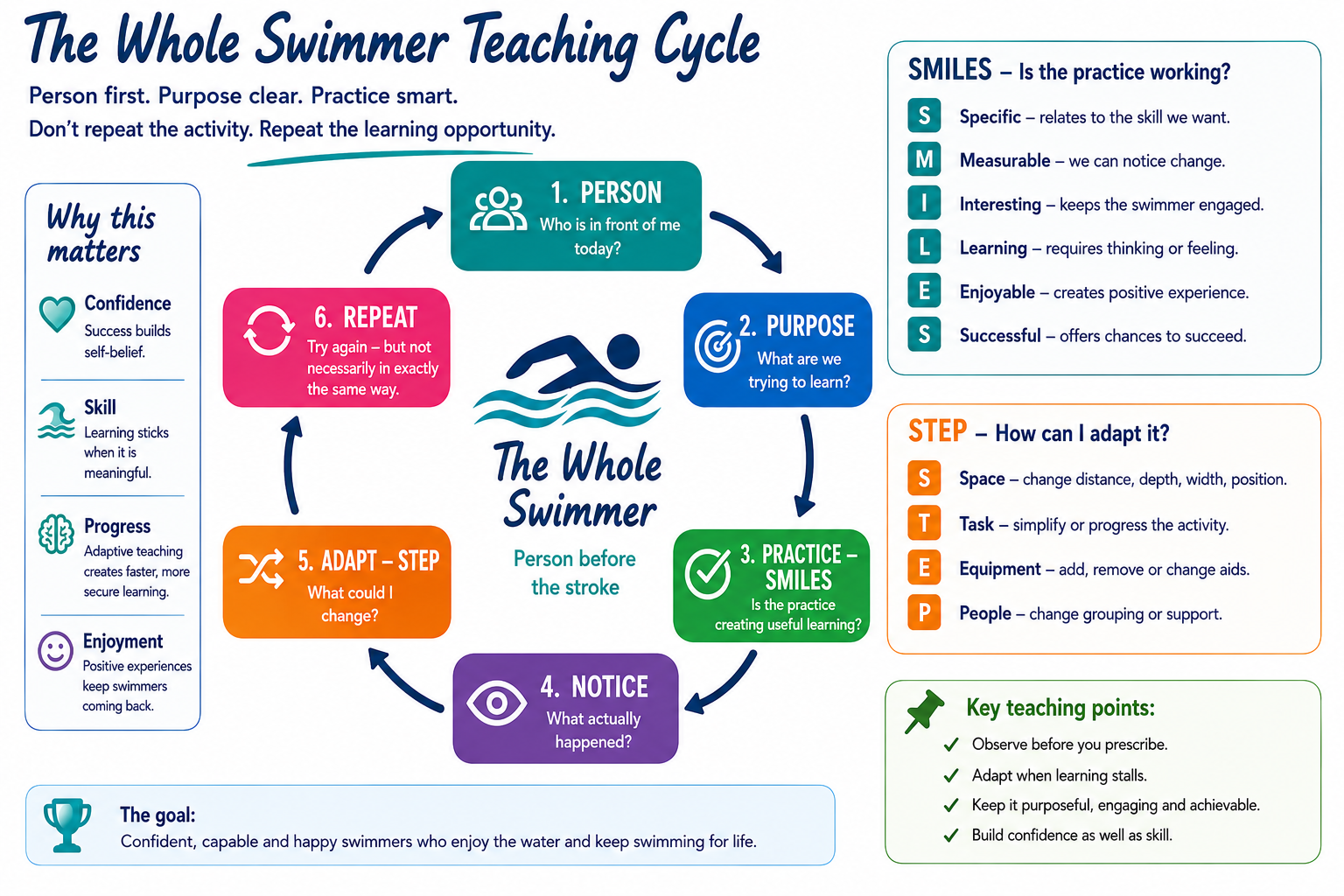
Person
Who is in front of me today?
Start with the swimmer. What can they do today? How comfortable and confident do they feel? What support, space or time might help them take part?
A stage or award level offers guidance, but it cannot tell us everything about a swimmer's readiness on a particular day.
Purpose
What are we trying to learn?
Choose one clear purpose for the practice. The swimmer might explore a comfortable floating position, breathe without rushing, or notice how body shape changes a glide.
When the purpose is clear, it becomes easier to tell whether an activity is helping.
Practice
Is the practice working?
Give the swimmer an opportunity to try, explore and respond. SMILES helps us consider the quality of that practice: is it Specific, Measurable, Interesting, Learning, Enjoyable and Successful for this swimmer?
These are questions for the teacher to consider, not another set of tests for the swimmer.
Notice
What actually happened?
Watch the movement and listen to the swimmer. What changed between attempts? Did the task feel manageable? Is the swimmer gaining understanding and control, or relying more heavily on prompts?
Notice what happened, rather than assuming that completing the activity meant the intended learning took place.
Adapt
What could I change?
If the practice is no longer helping, consider what to change. STEP offers four starting points: Space, Task, Equipment and People.
You might shorten the distance, change the starting position, move a marker, alter the support available or organise the swimmers differently. Choose a change that responds to what you noticed.
Repeat
What happens when we try again?
Give the swimmer another opportunity with that change in place. Notice whether it helped, and use their response to guide the next decision.
Repeat the learning opportunity, rather than simply repeating the activity. The cycle then begins again with the swimmer in front of you.
What might this look like at poolside?
A swimmer pushes from the wall towards a floating marker. The purpose is to explore a comfortable, balanced glide. They lift their head and stand almost immediately.
The teacher notices that the marker may be too far away and asks the swimmer how the attempt felt. They move it closer and offer a choice of starting position. The swimmer tries again, travels a shorter distance and feels more in control. That response helps the teacher decide whether to continue, adjust the task again or explore a new challenge.
“What is this swimmer learning from the activity, and what could I change to help them learn more?”
The Teaching Cycle is a guide for making decisions, not a fixed lesson sequence or an assessment of the swimmer. Pools can adapt their schemes and activities while keeping the person at the centre of each decision.
The Whole Swimmer Teaching Cycle © 2026 Michael D. Jones. Please credit Michael D. Jones and The Whole Swimmer, and link to this page when sharing or adapting this material.