
The Catch That Changes Everything: Early Vertical Forearm
EVF is one of the most discussed concepts in competitive swimming — and one of the most misunderstood. Here is what it actually means, and how to teach it.

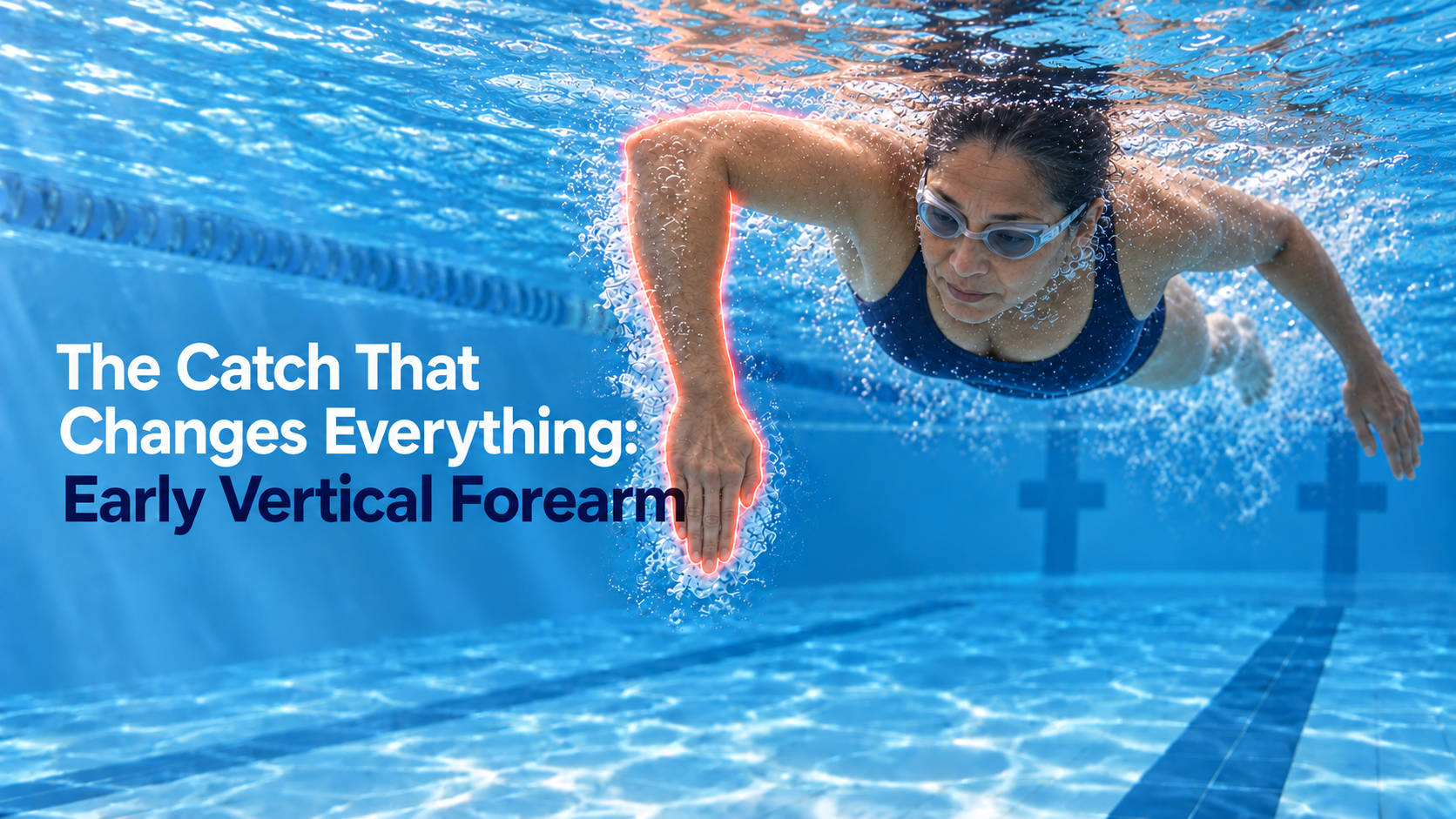
Ask any competitive swimming coach what separates a good freestyle from a great one, and most will point to the catch. Specifically, to something called Early Vertical Forearm — or EVF.
It is one of the most discussed concepts in the sport. It is also one of the most misunderstood, particularly when it comes to teaching it to non-elite swimmers. This piece is an attempt to cut through the noise.
What EVF Actually Is
Early Vertical Forearm describes the position of the forearm during the catch phase of the freestyle stroke. The goal is to get the forearm vertical — pointing straight down toward the pool floor — as early as possible in the pull, before the elbow begins to drop.
When done well, it allows the swimmer to use the entire forearm and hand as a single paddle, pressing against a large column of water. When done poorly — or when a swimmer attempts it without the shoulder mobility to support it — it can cause injury and actually reduce propulsion.
The key word in the name is early. The forearm needs to reach vertical before the elbow drops. Once the elbow drops, the lever is broken and the catch is lost.
Why It Matters for Swim Teachers
Most of your learners will never race competitively. So why does EVF matter in a teaching context?
Because the principles behind it — using the forearm as a paddle, maintaining a high elbow, pressing back rather than down — apply at every level of swimming. A recreational swimmer who understands how to use their forearm will move through the water more efficiently, with less effort, and with lower injury risk.
You do not need to teach EVF as a technical concept. But you do need to teach the mechanics it describes.
The Common Mistakes
Before you can teach the catch well, you need to recognise what goes wrong. The most common errors are:
Dropped elbow. The swimmer's elbow falls below the wrist during the catch, turning the forearm into a downward-pushing lever rather than a backward-pressing paddle. This is the single most common freestyle error at every level.
Pressing down, not back. Related to the above. When the elbow drops, the natural movement is to press the hand downward, which lifts the body but generates almost no forward propulsion.
Rushing the catch. Many swimmers — particularly those who have been told to increase their stroke rate — rush through the catch before the forearm has reached a useful position. Slowing the entry and extension phase often helps.
Overreaching. Swimmers who reach too far across the centreline during entry create internal rotation at the shoulder that makes a high-elbow catch almost impossible to achieve.
How to Teach It
The most effective approach I have found is to work backwards from the sensation rather than the position.
Start with a simple drill: ask the swimmer to stand in the water, arms extended forward at shoulder height, and press their hands and forearms backward through the water — not downward. Ask them to feel the resistance on the inside of the forearm. That resistance is what they are looking for in the catch.
From there, introduce the Doggy Paddle drill. Ask the swimmer to swim with a high head position, taking short, shallow strokes that keep the elbows high and the forearms pressing backward. It looks ungainly, but it isolates the catch mechanics beautifully.
Finally, introduce the Fingertip Drag drill to slow the recovery and encourage a high elbow position on entry. This creates the conditions for a better catch without requiring the swimmer to think about EVF directly.
A Note on Shoulder Mobility
EVF places significant demands on shoulder mobility, particularly internal rotation. Before pushing any swimmer toward a high-elbow catch, assess their range of motion. A swimmer with restricted shoulders who attempts to force EVF is at real risk of impingement.
For swimmers with limited mobility, focus on the principle — pressing back, not down — rather than the specific position. A slightly lower elbow with good backward pressure will always outperform a technically correct EVF that the swimmer cannot sustain.
The Takeaway
The catch is the foundation of an efficient freestyle. You do not need to use the term EVF with your learners — in fact, I would argue you probably should not. But understanding the mechanics it describes will make you a better teacher of the stroke.
Press back, not down. Keep the elbow high. Feel the water on the inside of the forearm. Everything else follows from there.
Explore Topics
Written by
Michael D. Jones
Swim teacher, educator and writer exploring swimming, learning and teaching beyond the stroke.